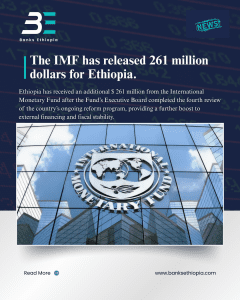
The IMF has released 261 million dollars for Ethiopia.
Ethiopia has received an additional $ 261 million from the International Monetary Fund after the Fund’s Executive Board completed the fourth review of the country’s ongoing reform program, providing a further boost to external financing and fiscal stability.
The latest disbursement brings the total IMF support under Ethiopia’s four-year Extended Credit Facility to approximately $ 2.18 billion, out of a total program envelope of about $ 3.4 billion approved in July 2024. The arrangement is designed to help the country address long-standing macroeconomic imbalances while supporting growth driven by private investment.
According to the IMF, Ethiopia’s programme implementation remains broadly on track. All quantitative performance benchmarks were met during the review period, alongside most indicative targets, signalling steady progress despite a challenging domestic and global environment.
The Fund noted that Ethiopia’s authorities have taken steps to contain the fiscal deficit and ensure that government spending remains consistent with programme objectives. Maintaining tight monetary conditions was described as essential to sustaining the recent disinflation trend and anchoring inflation expectations, while reforms in the foreign exchange market were cited as a positive development.
Economic growth is expected to strengthen further. The IMF projects real GDP growth of 9.2 percent in the 2024/25 fiscal year, compared with 8.1 percent a year earlier. Inflation, which has been a key concern in recent years, is forecast to decline sharply to 16 percent, down from 26.6 percent.
Despite these improvements, the Fund cautioned against pressures to loosen fiscal discipline. It urged the government to continue rationalising expenditure and gradually phase out fuel subsidies, arguing that this would help rebuild fiscal buffers and improve spending efficiency, while safeguarding social protection programmes for vulnerable households.
Public debt is projected to peak at 50.3 percent of GDP in 2024/25 before beginning a gradual decline as fiscal consolidation measures and debt restructuring efforts take hold. Ethiopia remains engaged in negotiations with external creditors under the G20 Common Framework, with the IMF welcoming recent progress with official creditors and noting that discussions with private bondholders are ongoing.
IMF Deputy Managing Director Nigel Clarke said recent gains in foreign exchange market reforms, revenue mobilisation, and financial sector regulation demonstrate forward momentum, but stressed that sustained commitment will be critical. “Maintaining the reform momentum remains key to the promising macroeconomic outlook,” he said.
The latest IMF disbursement is expected to help ease balance-of-payments pressures and support budget financing as Ethiopia continues to implement its Homegrown Economic Reform Agenda.