Ethiopia Plans New Law Requiring Banks to Allocate More Credit to Manufacturing
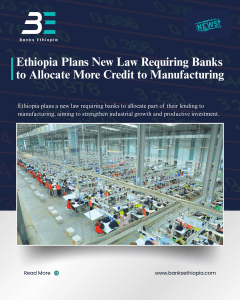
Ethiopia is preparing new legislation that will require banks to allocate a defined share of their lending to the manufacturing sector, marking a significant policy shift to reshape credit allocation across the economy.
Abiy Ahmed announced the opening of the fourth Ethiopia Tamirt Expo in Addis Ababa, where he said both state-owned and private banks will soon face legal obligations to ensure fairer financing access for industrial producers.
Addressing Credit Imbalances
According to the Prime Minister, government evaluations found that Ethiopia’s manufacturing sector continues to receive disproportionately low financing compared to sectors such as trade and services, despite years of policy efforts aimed at industrialization.
A steering committee tasked with resolving challenges related to land access, electricity, and finance reportedly concluded that credit availability remains one of the sector’s most persistent bottlenecks.
The proposed law would establish a mandatory lending quota, requiring banks to channel a specific percentage of their resources toward manufacturing and industrial production.
“The Ethiopian government is working on a law to clear the man-made hurdles that have prevented the industry from getting its fair share,” Abiy told participants at the expo.
Industrial Growth vs Limited Capital
While emphasizing the importance of industrial financing, the Prime Minister also acknowledged the structural limitations facing the economy. He cautioned that the measure alone would not immediately solve the financial needs of manufacturers, noting that the country’s overall capital base remains limited relative to demand.
He argued that the objective is not merely to expand lending, but to ensure existing financial resources are directed toward productive sectors capable of generating long-term economic value rather than remaining concentrated in trade activities or informal channels.
Banking Sector Under Growing Policy Direction
The planned legislation signals a more interventionist approach toward credit allocation within Ethiopia’s banking system. Total bank lending reached 2.42 trillion birr by the midpoint of the current fiscal year, according to the National Bank of Ethiopia.
Meanwhile, Commercial Bank of Ethiopia reported disbursing 514.6 billion birr in loans over the past nine months, with more than 90 percent directed toward the private sector.
The upcoming law could significantly influence lending strategies across the banking industry, particularly for private banks that have historically prioritized lower-risk and more liquid sectors.
Manufacturing at the Center of Economic Strategy
The push comes as Ethiopia intensifies efforts to strengthen domestic production, reduce import dependence, and expand export competitiveness under its industrial development agenda.
Abiy also called on manufacturers to work more closely with Ethiopian Investment Holdings to build companies capable of competing across African markets, signaling broader ambitions beyond local production.
The emphasis, he suggested, is shifting from simply manufacturing goods to building scalable industrial firms with regional export capacity.
A Structural Shift in Financial Policy
If enacted, the legislation would represent one of the most direct policy interventions into Ethiopia’s banking sector in recent years. It reflects a broader effort by policymakers to align financial flows with national development priorities, particularly industrialization and productive investment.
The key challenge, however, will be balancing developmental objectives with banking sector stability, profitability, and credit quality in an economy where capital remains constrained.
source: EBR