Ethiopia May Reconsider Fuel Vehicle Import Ban as WTO Accession Nears Final Stage
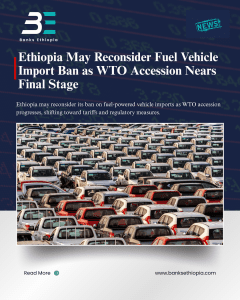
Ethiopia may soon revisit its restriction on fuel-powered vehicle imports, as the government aligns key policies with requirements for accession to the World Trade Organization (WTO).
The potential policy shift was signaled by Kassahun Gofe during the seventh Working Party Meeting on Ethiopia’s accession, where he indicated that the current ban could be replaced with tariff-based measures in line with WTO rules.
From Restriction to Regulation
Ethiopia imposed restrictions on fuel-powered vehicle imports in early 2024 as part of a broader push toward electric mobility and reduced fuel dependency. However, WTO principles require the free flow of goods, limiting the use of outright import bans.
Drawing parallels to recent reforms, Kassahun noted that the government has already lifted restrictions on used clothing imports, replacing them with applicable customs duties. A similar transition is now being considered for fuel-powered vehicles and three-wheelers.
This suggests a shift from prohibition to policy-based discouragement, where imports remain technically allowed but are shaped through taxation and regulatory measures.
Policy Flexibility Within WTO Rules
According to trade officials, lifting the restriction does not necessarily imply a full return to pre-2024 import levels. Tages Mulugeta clarified that Ethiopia intends to introduce alternative mechanisms—such as higher taxes or environmental policies—to limit the influx of fuel-based vehicles.
The approach reflects a balancing act: complying with WTO obligations while preserving national priorities around energy transition and environmental sustainability.
Accession at a Critical Juncture
Ethiopia’s more than two-decade effort to join the WTO is now entering what officials describe as a “critical juncture.” Since formally applying in 2003, the country has accelerated reforms over the past year, with fewer than ten bilateral agreements still pending.
The accession process has driven a broad set of structural changes, including:
- Liberalization of trade sectors to foreign participation
- Reforms in customs valuation systems
- Expansion of foreign currency account access
- Strengthening regulatory transparency
A key institutional reform highlighted during the negotiations is the consolidation of state-owned enterprises under Ethiopian Investment Holdings (EIH), aimed at improving governance, financial discipline, and operational efficiency.
Reform Momentum and Market Signals
Officials emphasize that these reforms are designed not only to meet WTO requirements but also to modernize Ethiopia’s economic framework. The introduction of independent boards and performance-based management for state-owned enterprises signals a shift toward market-oriented governance.
At the same time, opening previously restricted sectors to private and foreign investment reflects a broader effort to integrate Ethiopia into the global trading system.
A Strategic Trade-Off
The reconsideration of fuel-powered vehicle imports highlights the trade-offs embedded in WTO accession. While membership offers improved market access, investor confidence, and integration into global supply chains, it also requires policy adjustments that may conflict with domestic priorities.
For Ethiopia, the challenge lies in designing policy tools—such as tariffs and environmental regulations—that maintain strategic objectives without violating international trade rules.
Looking Ahead
As negotiations approach their final phase, Ethiopia is positioning itself as ready to assume the obligations of WTO membership. The outcome will not only shape trade policy but also influence sectors ranging from energy and transport to manufacturing and investment.
The potential return—albeit controlled—of fuel-powered vehicle imports is one signal among many: Ethiopia’s economic framework is evolving, with global integration increasingly shaping domestic policy choices.
Source: The Reporter