Ethiopia’s Inflation Returns to Double Digits: What It Means for the Economy
Overview
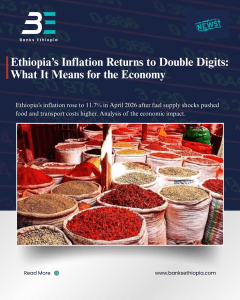
After months of hard-won progress, Ethiopia’s inflation has climbed back above the 10% threshold — a development that has drawn fresh attention from economists, policymakers, and financial institutions alike. According to data published by Bloomberg on May 7, 2026, headline inflation surged to 11.7% in April 2026, up sharply from 9.4% in March. This marks the first time in five months that inflation has crossed into double-digit territory, reversing a promising disinflation trend that had begun in mid-2024.
The Numbers at a Glance
| Indicator | April 2026 | March 2026 | Change |
|---|---|---|---|
| Headline Inflation (YoY) | 11.7% | 9.4% | ▲ +2.3 pts |
| Food Inflation | 13.5% | 11.0% | ▲ Surge |
| Non-Food Inflation | 9.1% | 7.0% | ▲ Rise |
| Transport Costs (YoY) | +13% | — | ▲ Sharp Rise |
Source: Ethiopian Statistics Agency / Bloomberg, May 2026
The Primary Driver: A Fuel Supply Crisis
The sharp jump in inflation is not the result of broad macroeconomic mismanagement. Rather, it is largely the consequence of a severe fuel supply challenge that rippled across the entire economy. Ethiopia, which imports all of its petroleum, has been caught in the crossfire of global energy market volatility driven by ongoing Middle East tensions.
The government was forced to adjust fuel prices twice in rapid succession, with kerosene — a staple energy source for millions of Ethiopian households — seeing particularly steep increases. The category covering gas and other fuels rose 3% in the month of April alone, according to the Ethiopian Statistics Agency.
The consequences were immediate and cascading:
- Transport costs surged 13% year-on-year, creating a direct “pass-through” effect to the cost of goods.
- Food prices, which constitute more than half of Ethiopia’s Consumer Price Index (CPI) basket, climbed by 2.4% within the month, driving food inflation to 13.5% annually.
- Protein staples such as meat, milk, and eggs; cooking oils and vegetables; and daily essentials like coffee and sugar all saw upward price pressure.
Context: A Hard-Won Disinflation Now Under Pressure
To understand the significance of April’s reading, it is important to recall how far Ethiopia had come. As recently as mid-2023, the country was battling an inflation rate of nearly 30% — the product of years of conflict, global commodity shocks, and expansionary monetary policy. In June 2023, year-on-year headline inflation stood at 29.3%.
The National Bank of Ethiopia (NBE) responded decisively, launching a comprehensive reform program in August 2023 and transitioning to an interest rate-based monetary policy framework in July 2024, adopting a policy rate — the National Bank Rate (NBR) — set at 15%. The IMF-backed reform program introduced a market-based exchange rate, tight credit growth caps, and fiscal discipline, including zero monetary financing of the budget deficit.
The results were remarkable. Inflation declined for six consecutive months through late 2025. By December 2025, headline inflation had fallen into single digits for the first time in many years — a milestone that Prime Minister Abiy Ahmed attributed to targeted subsidies, income adjustments, supply-chain reforms, and improvements in public services. The rate stood at 9.7% in February 2026, and the NBE’s Monetary Policy Committee (MPC), at its 6th meeting on March 21, 2026, reaffirmed its commitment to maintaining the tight monetary stance and kept the policy rate unchanged at 15%.
Yet even then, the MPC issued a prescient warning: geopolitical tensions in the Middle East posed upside risks to the inflation outlook, particularly through their potential impact on global oil prices and supply chains. That warning has now materialized.
The NBE’s Policy Stance: Holding Firm
The National Bank of Ethiopia has maintained its benchmark interest rate at 15% since its introduction, and signals from the central bank suggest the tight policy stance will continue. The MPC has emphasized that maintaining real interest rates in positive territory is essential to build credibility and sustain the single-digit inflation objective.
Key monetary developments as of early 2026: – Broad money growth: 39.3% year-on-year as of February 2026 – Bank credit growth: 45.3% year-on-year, a rapid expansion that the NBE is carefully monitoring – Base money growth: 43.2% year-on-year
The NBE has been gradually raising the credit growth cap — from 18% to 24% for FY 2025/26 — with plans to fully eliminate the ceiling by December 2026, subject to inflation and credit quality developments. This measured approach reflects the delicate balance between supporting economic growth and keeping inflation anchored.
Ethiopia’s External Sector: A Bright Spot
Despite inflationary pressures, Ethiopia’s external sector has demonstrated notable resilience. The country recorded a balance of payments surplus in the first half of fiscal year 2025/26, driven by:
- Strong growth in exports of goods, particularly coffee and gold
- Increased remittance inflows (up ~13% following the exchange rate reform)
- Rising capital account inflows linked to the July 2024 exchange rate liberalization
- Growth in services such as air transport and tourism
Foreign exchange reserves have been substantially boosted, helping the NBE manage liquidity and moderate inflation through FX auction sterilization.
What This Means for Businesses and Households
The return to double-digit inflation, while alarming at first glance, carries important nuances:
- This is a shock-driven, not structural, increase. The April spike is driven by identifiable external shocks — fuel supply disruption and global energy price volatility — rather than a breakdown of macroeconomic discipline.
- Ethiopia is not returning to the 20%+ era. The structural reforms of 2023–2024 remain intact. Fiscal discipline, a functioning monetary policy framework, and a more market-oriented exchange rate system provide meaningful buffers.
- The pass-through risk is real. As fuel costs permeate supply chains, businesses dependent on transport and logistics will face continued cost pressures in the near term. Pricing strategies should factor in a period of elevated inflation.
- Low-income households remain most vulnerable. Food accounts for over half of the CPI basket, meaning the inflationary burden falls disproportionately on those who spend the largest share of their income on necessities.
The Road Ahead
The IMF’s latest country report projects Ethiopia’s end-2025/26 inflation at approximately 12.0% year-on-year, a moderately higher forecast than the 10.2% projected at the Third Review, reflecting the impact of fuel and electricity price adjustments. The direction of inflation in the coming months will depend heavily on:
- The duration and intensity of Middle East conflicts and their effect on global oil prices
- The government’s fuel pricing and subsidy strategy going forward
- The NBE’s continued commitment to its tight monetary policy stance
- Progress on supply-side measures, including agricultural support and logistics improvements
The NBE has made clear it will not hesitate to use all available policy tools — the policy rate, open market operations, FX interventions, and reserve requirements — to keep inflation on a downward trajectory.
Conclusion
April 2026’s inflation reading is a reminder that economic stabilization is rarely a straight line. Ethiopia has achieved significant progress in its fight against inflation — progress that would have seemed unlikely just two years ago. The current uptick, driven by fuel supply pressures and global energy shocks, is a serious challenge but does not erase the structural gains made. For banks, businesses, and households, the key watchpoints in the months ahead are fuel price dynamics, monetary policy signals from the NBE, and the broader geopolitical environment.
Banks Ethiopia will continue to monitor macroeconomic developments and provide timely analysis to support informed financial decision-making.
Sources: Bloomberg (May 7, 2026), National Bank of Ethiopia MPC Statement (March 2026), Ethiopian Statistics Agency, IMF Country Report No. 26/20, Ethiopian News Agency.