Ethiopia’s Debt Talks Expose Flaws in G20 Framework, Paris Club Warns
The Paris Club has called for reforms to the G20 Common Framework for debt treatment, arguing that Ethiopia’s prolonged debt restructuring process highlights the need for a faster and more effective mechanism for resolving sovereign debt crises.
The call came in the creditor group’s 2025 annual report, released ahead of its annual meeting in Paris, where government creditors, borrowing countries, international financial institutions, and private investors gathered to discuss global sovereign debt challenges.
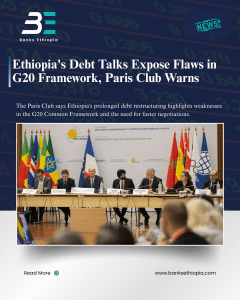
The Common Framework was launched by the G20 in 2020 to help low-income countries restructure unsustainable debt burdens following the economic disruptions caused by the COVID-19 pandemic. While several countries have completed restructurings under the initiative, the Paris Club said procedural weaknesses continue to delay agreements and create uncertainty for countries seeking debt relief.
“The Common Framework must deliver faster and swiftly embark all creditors in delivering comparable efforts,” Paris Club Co-Chair Thomas Revial said in the report.
Ethiopia has emerged as one of the most closely watched cases under the framework. The country remains engaged in debt restructuring negotiations involving official bilateral creditors and holders of its defaulted one-billion-dollar Eurobond.
Although official creditors reached an agreement in principle on Ethiopia’s debt treatment in March 2025, negotiations with bondholders have yet to be concluded.
The disagreement centers on the principle of comparability of treatment, which requires private creditors to provide debt relief broadly equivalent to that offered by official lenders. Official creditors, including China and France, rejected an earlier proposal negotiated with bondholders, arguing that it failed to meet that requirement.
Bondholders have pushed back, arguing that Ethiopia’s improving economic outlook and ongoing reform program do not justify the level of losses being sought. Some investors have also raised the possibility of legal action if negotiations fail to produce an acceptable outcome.
The dispute has increasingly become a focal point in broader discussions about the effectiveness of the Common Framework.
In a contribution to the Paris Club report, Astewaye Woldemichael, Senior Adviser at Ethiopia’s Ministry of Finance, argued that the framework’s current structure creates unnecessary delays by bringing private creditors into the process too late.
“The Common Framework’s implicit sequencing means that by the time a debtor engages bondholders, the analytical divergence between the IMF and private creditors has not been addressed,” Astewaye wrote. He argued that the IMF and official creditor committees should engage private creditors earlier rather than leaving debtor countries to bridge differences during negotiations.
The report revealed differing views on how the framework should evolve. Ethiopia, the International Monetary Fund, and the World Bank supported a process that would allow official and private creditors to negotiate simultaneously, while China called for stricter enforcement of comparability-of-treatment rules.
China, Ethiopia’s largest bilateral creditor, also expressed concern about the increasing use of litigation threats by bondholders during debt restructuring negotiations.
Xuan Changneng, Deputy Governor of the People’s Bank of China, called for coordinated efforts to discourage legal actions that could undermine restructuring agreements and weaken confidence in the Common Framework. He also urged stronger enforcement of burden-sharing principles among creditor groups.
The report further highlighted debates surrounding Preferred Creditor Status, a designation that generally shields institutions such as the IMF and World Bank from debt write-downs during restructurings. China and other stakeholders called for clearer rules governing which institutions qualify for the status, arguing that ambiguity has complicated debt negotiations in several countries.
Despite ongoing restructuring challenges, the report noted an improvement in the overall debt outlook for low-income countries. According to the Paris Club, 52 percent of low-income economies are now assessed as being at low or moderate risk of debt distress, while 48 percent remain at high risk or are already in distress. It is the first time since 2017 that countries in the lower-risk category have outnumbered those facing severe debt vulnerabilities.
Countries such as Ghana, Zambia, and Chad have largely completed debt restructurings under the Common Framework. Ethiopia’s unresolved negotiations, however, continue to test the mechanism’s ability to reconcile the interests of official lenders, multilateral institutions, and private investors.
As discussions over reform intensify, the outcome of Ethiopia’s debt restructuring is expected to influence future approaches to sovereign debt workouts and shape the evolution of the global framework designed to address them.
Source: Reuters