Ethiopia’s New 56,000 Birr License Plates Raise Questions Over Cost of Vehicle Registration Reform
Ethiopia has begun rolling out its long-awaited national vehicle registration system, introducing technologically advanced license plates equipped with RFID chips and QR codes. While transport authorities are presenting the initiative as a major modernization effort, public attention has quickly shifted to another aspect of the reform: its price.
Under the new fee structure, owners of privately owned fuel-powered vehicles must pay 56,000 birr for the new license plates. Electric vehicle owners will pay 44,500 birr, while public transport operators are required to pay 11,000 birr.
The launch marks one of the most significant changes to Ethiopia’s vehicle registration system in decades. Authorities say the new framework will create a unified national database, improve vehicle tracking, reduce fraud, and strengthen law enforcement capabilities. The system replaces region-based license plates with a standardized national format carrying the identifier “ETH” and the Ge’ez inscription “ኢት.”
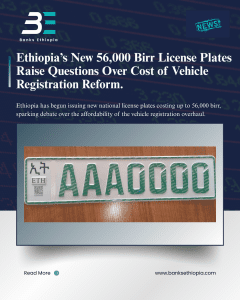
However, as implementation begins in Addis Ababa, the debate is increasingly centered on affordability rather than technology.
For many motorists, the cost of obtaining the new plates comes at a time when vehicle ownership has become considerably more expensive. Import costs, spare parts prices, insurance premiums, maintenance expenses, and fuel prices have all risen in recent years, increasing the overall financial burden on vehicle owners.
The government argues that the new registration system introduces capabilities that were absent from the previous framework. RFID technology and QR codes allow authorities to verify vehicle information electronically through a centralized database, reducing the risk of forgery, duplicate registrations, and administrative inefficiencies.
Transport officials have long maintained that Ethiopia’s previous registration system had become outdated. The old plates were vulnerable to damage and fraud and were managed through fragmented regional systems that limited information sharing between authorities.
The new platform seeks to address those challenges by establishing a single national registration standard. Authorities also believe the system will improve traffic enforcement and support broader digitalization efforts within the transport sector.
Yet the transition raises practical questions about implementation.
Addis Ababa alone is estimated to have around 800,000 registered vehicles. Although the current phase applies only to newly registered vehicles, authorities have confirmed that existing vehicles will eventually be incorporated into the new framework. Details regarding timelines and replacement procedures have not yet been announced.
For businesses operating large fleets, logistics companies, transport providers, and private motorists, the eventual nationwide transition could represent a substantial financial commitment.
The reform also arrives as Ethiopia increasingly embraces digital public services. From the expansion of the Fayda digital identification system to ongoing efforts to digitize tax administration and financial services, authorities are investing heavily in technology-driven public sector reforms.
The vehicle registration overhaul fits within that broader agenda. Officials argue that digital identification, centralized databases, and integrated monitoring systems are necessary components of a modern transport administration system.
Whether the public views the reform as a technological upgrade or an additional financial burden may ultimately depend on how the transition is managed in the coming years.
For now, the introduction of Ethiopia’s new national license plates represents more than a change in vehicle identification. It has also opened a wider discussion about the balance between modernization, public service delivery, and affordability in one of the country’s most ambitious transport sector reforms.
Source: Reporter