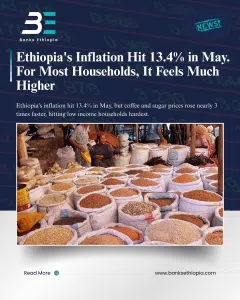
Ethiopia’s Inflation Hit 13.4% in May. For Most Households, It Feels Much Higher
Ethiopia’s annual inflation rate climbed to 13.4 percent in May 2026, up from 11.7 percent in April and 9.4 percent in March, the third consecutive month of acceleration after a brief stretch in single digits late last year. On paper, that is a notable but not alarming shift. In the kitchens and markets where the number is actually felt, it is a different story entirely.
The gap between the headline figure and the lived experience of an Ethiopian household is not a matter of perception. It is built into the index’s architecture and into the specific items driving this month’s increase.
What the Average Hides
Ethiopia’s Consumer Price Index weights every item in the basket according to its statistical share, not its importance to a given household. Based on the most recent officially documented weighting, drawn from the 2016 Household Income, Consumption and Expenditure Survey, food and non-alcoholic beverages account for 45.8 percent of the national basket. That national figure already hides the real story, because it blends households with very different spending patterns. Broken down by income group, the gap is stark.
| Income group | Share of spending on food |
|---|---|
| Lowest income households | 63.8% |
| Middle-income households | 55.0% |
| Highest income households | 41.7% |
| National average | 45.8% |
Source: Ethiopia Household Income, Consumption and Expenditure Survey (2016), the base for ESS’s current CPI weighting; cited in International Growth Centre, Distributional Impacts of Inflation in Ethiopia (2022). A rebase using December 2022 data was planned but has not been confirmed as completed; no ESS report through April 2026 references a new base year.
A household in the lowest income bracket spends nearly two-thirds of everything it has on food. A household in the top bracket spends less than half that share. A household with substantial non-food consumption, a fixed rent, a car already paid off, and school fees set annually will barely notice an inflation print built largely on volatile food costs. A household spending almost two-thirds of its income on food has nowhere to hide.
That is precisely the dynamic behind May’s increase. Food inflation reached 15 percent year on year, but the average understates how unevenly the pressure falls across the basket. A handful of staple items rose two to three times faster than the headline rate itself.
| Basket item | Annual increase | Multiple of headline |
|---|---|---|
| Coffee & non-alcoholic beverages | 40.9% | 3.1x |
| Sugar, jam, honey & chocolate | 36.9% | 2.8x |
| Meat | 19.5% | 1.5x |
| Milk, cheese & eggs | 19.3% | 1.4x |
| Oils & fats | 17.4% | 1.3x |
| Fruit | 17.1% | 1.3x |
| Headline inflation (reference) | 13.4% | 1.0x |
Source: Ethiopian Statistical Service CPI data, May 2026, as reported by Birr Metrics.
Coffee and non-alcoholic beverages, a near-daily purchase for most households, rose nearly 41 percent. Sugar, jam, honey, and chocolate climbed almost 37 percent. Even the more moderate increases in this group, meat, dairy and eggs, oils and fats, fruit, still outpaced the headline figure by close to fifty percent. None of these are discretionary items that a squeezed household can simply defer.
Three Months, One Direction
This is not a single-month spike. Headline inflation has now accelerated for three consecutive months, climbing from 9.4 percent in March to 11.7 percent in April to 13.4 percent in May, reversing a disinflation trend that had pushed the rate below 10 percent as recently as December 2025. That earlier decline had been presented as one of the clearer wins of the macroeconomic reform program launched alongside the birr float in mid 2024, evidence that tighter monetary policy and improving supply conditions were taking hold. The reversal raises an uncomfortable question for policymakers: whether those gains were durable or reflected a temporary lull before exchange-rate pass-through and seasonal food pressures caught up again.
Who Actually Pays
Economists describe this dynamic through what is known as Engel’s law: as household income falls, the share of that income spent on food rises. Ethiopia’s own household survey data shows just how large that effect is, a 22 percentage point gap in food’s share of spending between the bottom and top income groups. A single inflation print therefore carries very different weight depending on where a household sits on the income ladder. For salaried, urban, middle-income earners, a 13.4 percent headline figure means a tighter monthly budget or a delayed purchase. For households nearer the poverty line, who were already spending close to two-thirds of their income on food before this latest run-up, a 15 percent rise in food costs and a near 41 percent jump in coffee and beverage prices is not an abstraction. It moves through most of what the household has.
This is why the most useful way to read May’s inflation print is not as a single number but as a distribution. The 13.4 percent figure is an average across very different realities, and the households least equipped to absorb the increase are the ones experiencing it most acutely.
What to Watch
This print did nothing to ease the central bank’s position. The National Bank of Ethiopia has maintained a tight monetary policy stance specifically to anchor inflation expectations, and a third consecutive monthly acceleration complicates any near-term case for loosening it. For ordinary households, however, the policy debate is secondary to a simpler question: whether June’s print continues the climb, or whether May proves to be the peak of the current cycle. Until that answer arrives, the gap between the official inflation rate and what families are actually paying at the market will keep widening.
source: Birrmetrics