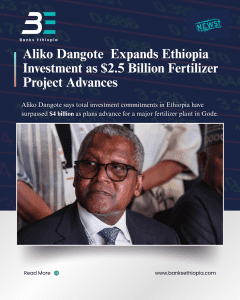
Aliko Dangote Expands Ethiopia Investment as $2.5 Billion Fertilizer Project Advances
Aliko Dangote visited Ethiopia over the weekend as discussions advanced around a major fertilizer investment project that could significantly reshape the country’s agricultural and industrial landscape.
The visit comes as the Dangote Group moves forward with plans to develop a large-scale urea fertilizer plant in Gode, located in Ethiopia’s Somali region.
The Ethiopian government and Dangote Group had previously agreed on a $2.5 billion investment deal for the project, which is expected to produce 3 million metric tonnes of urea annually.
Authorities view the project as strategically important to Ethiopia’s long-term goal of achieving fertilizer self-sufficiency, reducing import dependence, and strengthening regional export capacity.
Ethiopia Pushes Food Security and Industrial Expansion
Abiy Ahmed described food security as a “strategic intervention” as the government deepens cooperation with Dangote Group on the project.
According to the Prime Minister, the partnership reflects a broader shared economic vision between Ethiopia and the Nigerian industrial conglomerate.
“Our interest is to have him in many areas because he’s delivering. As a government, we want to support him and realize our common vision. It’s a win-win for both of us,” Abiy said.
The Prime Minister emphasized that the project could play a major role in supporting agricultural productivity, industrialization, and broader economic development.
Total Ethiopia Investment Commitment Surpasses $4 Billion
Dangote Group later announced that its total investment commitment in Ethiopia has now exceeded $4 billion, following the expansion of infrastructure components linked to the fertilizer project.
According to the company, the broader investment package will include:
- A 110-kilometer pipeline
- A 120-megawatt power plant
- A polypropylene packaging facility
- A two-million-tonne NPK blending plant
The expanded infrastructure is expected to support both fertilizer production and long-term industrial operations tied to the project.
Dangote described Ethiopia as one of the group’s most significant investment destinations across Africa.
“Ethiopia actually is the second largest receiver of our own investment,” he said.
Fertilizer Supply Remains Strategically Important
The project comes as fertilizer supply and agricultural productivity remain central concerns for Ethiopia’s economy, where agriculture continues to support a large share of employment and export activity.
Ethiopia has historically relied heavily on imported fertilizer, exposing the country to foreign exchange pressure and global commodity price volatility.
Officials believe domestic fertilizer production could:
- Reduce import costs
- Improve agricultural supply stability
- Support food security objectives
- Expand industrial manufacturing capacity
- Strengthen export potential in regional markets
The investment also aligns with Ethiopia’s broader industrialization agenda, which seeks to attract large-scale foreign investment into manufacturing, infrastructure, and value-added production sectors.