Caught in a Price Trap: How Fixed Floors and Shifting Markets Triggered Ethiopia’s Coffee Export Crunch
Ethiopia’s premier foreign currency engine is navigating a turbulent macro-environmental shift. Following a historic fiscal cycle that saw coffee export earnings soar to an all-time high of $2.65 billion USD, recent market data reveals a sharp contraction in shipment volumes.
According to data from the International Coffee Organization (ICO), combined exports from Ethiopia and Guatemala in the “Other Milds” Arabica category plummeted 26.1% year-on-year, dropping to 0.48 million bags. While economists attribute part of the drop to a “base effect” from the exceptional, front-loaded pricing peak of last year, the downturn has exposed deep structural strains across Ethiopia’s newly floated currency regime, export houses, and smallholder farming communities.
The Macro Picture: Quick-Glance Metrics
| Market Factor | 2024/2025 Peak Cycle | Current Position (Mid-2026) |
| Global NY “C” Arabica Futures | ~$3.90 – $4.25 / lb | ~$2.56 – $2.80 / lb |
| Domestic Farmgate Cherry Price | 35 – 50 ETB / kg | 220 – 250 ETB / kg |
| Dominant Processing Type | High-Premium Washed | Shift to Home-Dried Naturals |
| Exchange Rate Framework | Pegged / Crawling Peg | Market-Based (Floated Birr) |
| Volume Performance | Record-High Shipments | ~74% of Planned Volume Target |
The Currency Strain: FX Liquidity Choke Points in the Floated Birr
The export slowdown arrives at an incredibly delicate juncture for Ethiopia’s financial sector, coming on the heels of the National Bank of Ethiopia’s (NBE) historic transition to a market-based foreign exchange regime. Because coffee traditionally accounts for up to one-third of the nation’s merchandise export earnings, any volume dip reverberates immediately through the interbank market.
- Commercial Bank Backlogs: A double-digit slide in inbound U.S. dollars means commercial bank vaults are seeing thinner foreign cash inflows. This directly slows down the clearing of backlogged Letters of Credit (LCs), making it more difficult for commercial banks to allocate FX for essential industrial imports, machinery, and pharmaceuticals.
- Alternative Trade Corridors: In a direct symptom of this dollar scarcity, the Ethiopian Coffee and Tea Authority (ECTA) has begun fast-tracking a strategic barter trade framework with booming buyers like China (now Ethiopia’s 3rd largest coffee market). Under this emerging framework, Ethiopia aims to exchange direct coffee shipments for essential technology and machinery, entirely bypassing the formal U.S. dollar loop.
The Exporter Price Trap: Fixed State Floors vs. Crashing Global Futures
Ethiopian coffee exporters are currently facing an aggressive cash-flow freeze. They are caught in a classic “price trap”—stuck between soaring domestic procurement costs and rigid national regulatory policies that have failed to keep pace with a cooling global market.
The Mechanics of the Trap: The National Bank of Ethiopia and ECTA enforce strict weekly Minimum Export Prices (Price Floors) to prevent under-invoicing and maximize national foreign exchange revenue. If an exporter signs an international contract even a cent below this state-mandated floor, the central bank rejects the contract and denies a shipping permit.
- The Global Slump: Global Arabica futures have plunged nearly 30% from their recent peaks, sliding down toward 256 US cents/lb. This correction is heavily driven by improved supply expectations from South America, where Brazil is projecting a massive crop featuring a 28% surge in Arabica output.
- The Hoarding Risk: Because local exporters aggressively bought fresh cherries at record-high domestic rates (220 to 250 ETB/kg) during the harvest, their break-even margins are exceptionally high. With global buyers refusing to pay Ethiopia’s artificially high fixed floors, and exporters legally barred from discounting their stock to match global realities, inventory is piling up in warehouses. The National Coffee Association recently issued an urgent warning against speculative hoarding, noting that holding onto overpriced inventory poses severe financial and legal risks to trading houses.
The Farmer Reality: High Nominal Profits Squeezed by Devaluation Costs
For smallholders, the narrative is an intricate paradox: they are generating more paper currency than ever before, but structural operational shifts are completely rewriting their financial landscape.
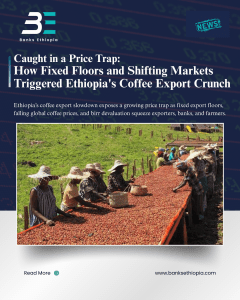
- The Washed-to-Natural Pivot: Because dried natural coffee brought in highly competitive returns last season, millions of smallholders bypassed commercial washing stations entirely. Choosing to sun-dry cherries on home-built raised beds to sell directly as “naturals,” they triggered an acute shortage of premium washed coffees. This structural pivot has forced several localized washing stations to suspend operations due to a lack of raw cherry supply.
- The Inflationary Offset: While receiving up to four times more for their raw cherries than in previous cycles sounds lucrative, the farmers’ actual purchasing power has been heavily eroded by the broader macroeconomic reality. Following the devaluation of the Birr, the cost of daily manual picking labor, fuel, transportation, and agricultural inputs has surged in tandem, washing away much of the nominal farmgate gains.
- The Regulatory Compliance Clock: Compounding these issues are tightening global trade compliance rules, particularly the European Union Deforestation Regulation (EUDR). The administrative cost of mapping individual smallholder plots and ensuring full digital traceability is creating a heavy compliance hurdle for local cooperatives, threatening their long-term access to premium European buyers.
Conclusion: Aligning Policy with Market Realities
Ultimately, Ethiopia’s current coffee export slowdown is not a failure of agricultural production, but a symptom of commercial misalignment. The country’s coffee farms remain highly productive, and global demand for Ethiopia’s unique, premium flavor profiles remains fundamentally strong.
However, the current deadlock highlights the friction that occurs when rigid, state-mandated minimum export floors collide with a cooling global commodities market and high domestic production costs. For the export pipeline to clear and for vital foreign currency inflows to resume their normal pace, regulatory frameworks will need to become as dynamic as the floated currency regime they support. Introducing more flexible, market-indexed pricing mechanisms will be essential to unlocking stuck inventory, relieving the squeeze on exporters, and ensuring that the entire supply chain—from the central bank to the smallholder farmer—can successfully weather global market corrections.