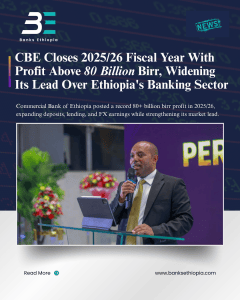
CBE Closes 2025/26 Fiscal Year With Profit Above 80 Billion Birr, Widening Its Lead Over Ethiopia’s Banking Sector
The Commercial Bank of Ethiopia closed the 2025/26 fiscal year with an annual profit exceeding 80 billion birr, the highest in the state-owned lender’s history, according to results the bank announced on July 1. The figure caps a year in which CBE expanded deposits, lending, and foreign currency generation at a pace that outstripped its own prior-year performance and much of the rest of the banking sector combined.
Customer deposits at the bank climbed past 2.4 trillion birr by year-end, after CBE mobilised 707.4 billion birr in new deposits during the fiscal year, up from 515 billion birr the previous year. That growth lifted the bank’s deposit base from 1.69 trillion birr at the start of the year, a jump of roughly 42 percent in twelve months.
Lending activity grew at a similar pace. CBE disbursed 648 billion birr in loans over the year, compared with 458.4 billion birr in 2024/25. Private sector borrowers absorbed the bulk of that growth, receiving 588 billion birr, or 90 percent of total disbursements, up from 404.8 billion birr, or 88.3 percent, a year earlier. The bank also reported loan recoveries of 546 billion birr, a 91 percent increase year-on-year, alongside 5.6 billion US dollars in foreign currency generation, including 2.1 billion US dollars from export proceeds.
CBE President Abe Sano attributed the results to the bank’s staff, customers, and government support, and said the bank is targeting 832 billion birr in deposit mobilisation and 360 billion birr in revenue for the 2026/27 fiscal year, both above what it achieved this year.
A Dominant Position Gets More Dominant
CBE’s results arrive against a backdrop of record profitability across Ethiopia’s banking industry. The National Bank of Ethiopia’s most recent Financial Stability Report, covering the fiscal year that ended in June 2025, found that sector-wide total income rose 78.8 percent to 646.3 billion birr, while net profit after tax climbed 61.3 percent to 93.4 billion birr, the highest annual earnings the industry has recorded. Other lenders posted strong results of their own this year: Awash Bank, Ethiopia’s largest private bank, reported earnings of 40.7 billion birr for the fiscal year ended June 30, 2026.
Even within that broader expansion, CBE’s share of the sector stands out. The NBE report found that the state-owned bank accounted for 49.1 percent of total banking assets and 51.7 percent of outstanding loans and bonds as of June 2025, a position the central bank described as making CBE the only systemically important bank in Ethiopia’s financial system. This year’s results suggest that concentration has continued to build rather than ease, as CBE’s deposit and lending growth rates outpaced the sector averages recorded in the NBE’s own review period.
The central bank’s report was explicit about the risks that concentration of this scale carries. It flagged rising exposure across market share, large depositors, liquidity distribution, sectoral lending, and geographic reach, risks that become more consequential the larger a single institution’s footprint becomes relative to the system it operates within. A shock to CBE’s balance sheet, in other words, would not be a contained event; it would be a systemic one.
That said, the picture is not simply one of an unchallenged incumbent squeezing out competition. The sector as a whole grew total assets by 44.5 percent to 4.7 trillion birr over the NBE’s review period, and profitability indicators improved across the industry, with return on assets rising to 2.5 percent and return on equity to 27.4 percent. Private banks such as Awash are also posting record results, and Ethiopia’s post-liberalisation reforms, including the move to a market-based exchange rate and interest-rate-focused monetary policy, are still working their way through a banking system that was largely closed to foreign competition until recently. CBE’s growth this year reflects both its structural advantages as the state’s flagship lender and a sector-wide tailwind that has lifted most major banks.
Whether CBE’s expanding share of deposits and lending becomes a policy concern or simply a feature of Ethiopia’s bank-dominated financial system will likely depend on how the sector’s newer entrants and private banks perform as liberalisation deepens, and on whether the central bank’s monitoring of concentration risk translates into any regulatory response.