BANKS ETHIOPIA | Consumer Economy |
For Ordinary Addis Residents, the Cost of Living Has Become Harder to Bear
Sustained inflation is eroding the daily survival strategies of urban households. With food prices now outpacing general inflation, families across the capital are finding that even careful spending is no longer enough.
The pressure of rising prices on everyday life in Addis Abeba has deepened noticeably in recent months, with food costs accelerating beyond both headline inflation and the non-food categories that dominated price pressures a year ago. For salaried workers, small traders, restaurant operators, and low-income households, the squeeze is no longer felt as an occasional spike. It has become a structural feature of the month.
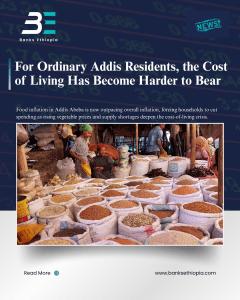
Addis residents and businesses are continuously adjusting their buying habits—reducing quantities, opting for cheaper alternatives, or skipping meals—only to find these measures insufficient as prices outpace adaptations. The vegetable stall, previously a flexible budget area, has now become a critical pressure point.
Food Inflation Overtakes the Basket
Data from the Ethiopian Statistical Service (ESS) for May 2026 shows food and non-alcoholic beverages inflation reaching 15 percent year-on-year, surpassing the 13.4 percent headline rate and the 11.1 percent recorded for non-food items. The gap marks a significant reversal from the same period a year earlier, when food inflation stood at 12.1 percent — well below non-food inflation of 17.8 percent.
Within the food basket, vegetables have emerged as a leading driver. Vegetable prices rose 12.3 percent year-on-year in May, contributing roughly 1.5 percentage points to headline inflation — more than the 1.1 points from bread and cereals, despite cereals carrying the larger basket weight at 17.1 percent. The pressure from vegetables is amplified by their role in daily cooking: they are purchased frequently, cannot easily be substituted, and spoil quickly, limiting the bulk-buying strategies households use to manage costs.
Non-alcoholic beverages and coffee recorded the steepest year-on-year surge at 40.9 percent, though vegetables stand apart because of how central they are to the consumption basket and how directly their price volatility is felt at the household level.
A Supply Problem With Rural Roots
The vegetable shortage now visible in Addis Abeba markets is not simply the result of rising demand. It reflects a supply chain that has been disrupted at the production stage. Reporting by Addis Fortune indicates that farm-gate onion prices collapsed to as low as 16 birr per kilogram approximately six months ago, leaving farmers with severe losses and, in some cases, unable to harvest crops already in the ground.
Stripped of working capital, many smallholder vegetable farmers have responded by shifting to lower-risk staple crops such as maize and wheat — a rational response to financial devastation that has significantly reduced the volume of vegetables reaching urban markets. The shortage now driving retail prices above 150 birr per kilogram in some parts of the capital is, in this sense, the downstream consequence of an earlier price collapse that received little policy attention at the time.
Transport costs compound the problem. Long-haul freight charges have risen sharply, and informal payments along supply routes add further unpredictability to what retailers pay before produce reaches the stall. Economists point out that, unlike manufacturing — where output can be scaled up within days — agricultural supply cannot be quickly adjusted. Once a planting season is lost to financial stress, the recovery in supply takes a full growing cycle.
Urban Households Absorb the Cost
Daily life in Addis Abeba requires constant recalculation. Workers now buy smaller quantities of produce more frequently to prevent spoilage, though paying premiums for small amounts often negates any savings.
For low-income families, the strain is severe as wages fail to match food price hikes. Basic groceries consume most earnings, leaving little for rent, transport, or healthcare, making household budget surpluses unattainable for many.
Food businesses face similar pressures, balancing high input costs with customers’ diminished purchasing power. Operators either raise prices and risk losing clients or hold them steady and lose margins; both paths often lead to lower-grade substitutions. Some managers even report that quality produce is occasionally entirely unavailable.
Policy Measures Have So Far Been Limited
The city administration has deployed 256 subsidised Sunday markets across Addis Abeba in an effort to cap vegetable prices, with target prices for onions set at 85 to 90 birr per kilogram against an open market price that has reached 160 birr. The intervention provides some relief to residents able to access and time their shopping around these markets, but its reach is limited relative to the scale of the supply shortfall and the number of households affected.
Broader structural responses — addressing transport infrastructure, rural financial access, and the farm-gate price volatility that triggered the current cycle — remain at an early stage. Until supply-side conditions improve and the cost of moving produce from farm to city becomes more stable and predictable, relief from food price inflation in Addis Abeba is likely to remain partial and temporary.
For the majority of the capital’s residents, the adjustment has already been made — in smaller portions, fewer ingredients, and a monthly budget that stretches further but covers less.
Sources: Ethiopian Statistical Service (ESS), Consumer Price Index, May 2026; Addis Fortune, June 21, 2026.