16 Billion Birr Still Unsettled Across Federal Institutions, Auditor General Warns
More than 16 billion birr in outstanding receivables remains unsettled across Ethiopia’s federal institutions, highlighting persistent weaknesses in public financial management despite ongoing improvements in government oversight and accountability systems.
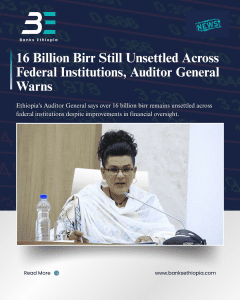
The finding was disclosed by the Office of the Federal Auditor General during a presentation to the House of Peoples’ Representatives on the results of financial legality and performance audits conducted for the 2024/25 fiscal year.
According to the audit, 138 federal institutions and 18 branch offices were carrying unresolved receivable balances at the close of the fiscal year. Receivables represent funds owed to government entities that have not yet been collected, recovered, or properly settled.
The scale of the outstanding balance underscores the challenges public institutions continue to face in monitoring, collecting, and managing funds owed to the government. Financial experts note that large volumes of unsettled receivables can undermine fiscal efficiency, constrain budget execution, and increase the risk of resource waste.
While the figure remains significant, auditors reported notable progress compared with previous years. Outstanding receivables declined by more than 50 percent compared to levels recorded in the 2016 Ethiopian fiscal year, suggesting that efforts to strengthen financial controls and follow-up mechanisms are beginning to yield results.
However, the Auditor General cautioned that unresolved receivables continue to expose public institutions to financial risks and reduce the effectiveness of public resource management.
Several major government institutions accounted for a substantial portion of the unsettled balances. These include ministries overseeing health, education, urban development, irrigation, and disaster risk management, as well as some of the country’s largest public universities.
The findings come at a time when Ethiopia is pursuing broad economic reforms aimed at improving fiscal discipline, strengthening public sector efficiency, and enhancing accountability across government institutions.
As the government seeks to mobilize domestic resources and improve public financial management, the efficient recovery of outstanding receivables is increasingly viewed as an important component of fiscal sustainability. Recovering funds already owed to public institutions can help strengthen cash flows and reduce pressure on government finances without introducing additional borrowing requirements.
Beyond receivable accounts, the audit report offered a broader assessment of financial compliance across federal institutions. The majority of audited entities received clean audit opinions, indicating that their financial statements largely complied with applicable standards and reporting requirements.
According to the report, 132 institutions secured unqualified audit opinions, while 26 received qualified opinions reflecting limited exceptions. Five institutions received adverse opinions due to significant financial reporting concerns.
The Auditor General’s office also reported achieving 99.3 percent audit coverage of development-related budget expenditures during the fiscal year, reflecting expanded oversight of public spending and government-funded projects.
The latest findings suggest that while Ethiopia has made progress in improving public financial governance, substantial challenges remain in ensuring that funds owed to government institutions are collected and properly accounted for.
With more than 16 billion birr still tied up in unsettled accounts, the report highlights an area where further reforms and stronger institutional controls could unlock additional resources and improve the overall efficiency of public finance management.
source: EBR