Ethiopia to Launch Real Estate Property Tax in Major Cities This Fiscal Year
The Ethiopian government is preparing to introduce a real estate property tax in major cities during the 2026/27 fiscal year, marking a significant step in its efforts to strengthen domestic revenue and reduce reliance on external financing.
According to the International Monetary Fund’s (IMF) latest country report, the rollout will begin in selected urban centres following the enactment of Ethiopia’s Real Estate Property Tax Proclamation in January 2025. The reform will be implemented gradually in collaboration with regional governments before expanding nationwide.
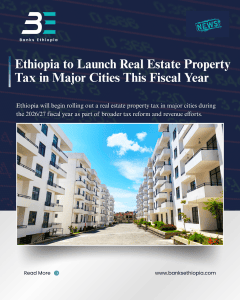
The initial phase will focus on establishing the foundations of the new tax system, including property valuation, registration, billing mechanisms, and taxpayer awareness campaigns. Once these systems are in place, implementation will progressively extend to additional cities and regions.
The IMF said the reform is expected to generate revenue equivalent to at least 0.3 percent of Ethiopia’s gross domestic product (GDP) over the medium term, providing local governments with a more stable and sustainable source of financing.
The World Bank Group is supporting the implementation of the property tax as part of Ethiopia’s National Medium-Term Revenue Strategy, which aims to broaden the country’s tax base and improve domestic resource mobilisation.
The property tax forms part of a wider package of fiscal reforms currently underway. Other planned measures include the introduction of an excise stamp and digital product-tracking system, implementation of motor vehicle circulation taxes, strengthened tax compliance measures, and greater use of digital technologies to modernise tax administration.
According to the IMF, reforms introduced under Ethiopia’s 2025 Income Tax Proclamation are also progressing, supported by stronger direct tax collection, quarterly corporate income tax payments, and measures to improve tax incentive management and reporting.
Together, the new initiatives are expected to raise Ethiopia’s tax-to-GDP ratio by an additional 0.6 percentage points during the 2026/27 fiscal year, supporting the government’s medium-term fiscal consolidation programme.
Although Ethiopia already levies taxes related to land use, rental income, and property transfers, the new framework introduces a dedicated annual real estate property tax supported by systematic property valuation, registration, and recurring billing. The reform is expected to reshape municipal revenue collection as implementation begins in the country’s largest cities before expanding nationwide.
Source: EBR