NBE Reaffirms Ban on Virtual Assets, Warns Public Against Crypto Transactions
The National Bank of Ethiopia (NBE) has reiterated that all transactions involving virtual assets remain prohibited in the country unless specifically authorized by the central bank, warning the public against engaging in cryptocurrency and other digital asset activities.
In a public notice issued on Thursday, the central bank clarified that the prohibition extends beyond cryptocurrencies and covers a broad range of virtual assets that can be electronically traded, transferred, exchanged, or used for payments, investment, or similar purposes.
What Are Virtual Assets?
| Category | Examples | Status Under NBE Notice |
| Cryptocurrencies | Bitcoin (BTC), Ethereum (ETH) | Prohibited unless authorized |
| Stablecoins | USDT (Tether), USDC | Prohibited unless authorized |
| Digital Tokens | Utility and investment tokens | Prohibited unless authorized |
| Virtual Asset Services | Trading, exchange, custody and transfers | Prohibited unless authorized |
| NBE-Regulated Digital Payments | Telebirr, bank mobile apps, electronic banking | Not affected by the notice |
Unlike regulated digital payment services such as Telebirr and electronic banking platforms, virtual assets generally refer to blockchain-based digital assets that can be traded, transferred, or used for investment or payment purposes but are not issued or authorized by the National Bank of Ethiopia.
According to the NBE, the restriction applies to the purchase, sale, exchange, transfer, trading, settlement, and facilitation of transactions involving virtual assets under Ethiopia’s existing legal framework.
The central bank also outlined several activities that remain prohibited, including exchanging virtual assets for fiat currencies, exchanging one virtual asset for another, transferring virtual assets, safeguarding or administering digital assets, and providing financial services related to the issuance or sale of virtual assets.
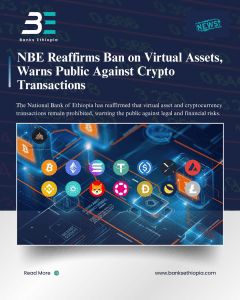
By issuing the clarification, the NBE sought to ensure that the public does not interpret the prohibition as applying only to cryptocurrencies such as Bitcoin. Instead, the notice makes clear that the restriction encompasses a wider category of digital assets and related financial services.
The regulator warned individuals and businesses against virtual asset transactions, citing severe risks such as fraud, cyberattacks, market manipulation, and major financial losses.
This notice reinforces the National Bank’s cautious approach to virtual assets as Ethiopia modernizes its financial sector and maintains strict oversight of payment systems and emerging technologies.
Despite recent digital payment reforms and fintech innovation, the central bank maintains that virtual assets remain outside Ethiopia’s authorized financial system unless explicitly regulated in the future.