Food Inflation Surges to 18-Month High, Outpacing Headline Inflation Again
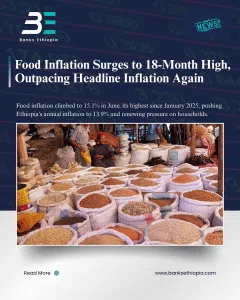
Food inflation climbed to 15.1 percent in June, its highest reading since January 2025, according to the Ethiopian Statistical Service’s Consumer Price Index release. The increase extends a run that has now pushed food costs above headline inflation for two straight months, deepening the strain on household budgets across the country.
Ethiopia’s overall inflation rate reached 13.9 percent in June, up from 13.4 percent in May and the highest level in a year. But the headline figure understates what most families feel at the market. Food and non-alcoholic beverages, the single largest line item in most household budgets, rose faster than the general basket for a second consecutive month, widening the gap between what wage earners bring home and what it costs to eat.
Where the Pressure Is Building
The ESS breakdown shows the pressure is broad rather than concentrated in one commodity. Bread and cereals, a staple for lower-income households, rose 7.3 percent year on year. Vegetables climbed 12.8 percent. Meat prices, while still running at 19.2 percent, actually eased from the previous month, offering one of the only signs of relief within the food basket.
Non-food inflation accelerated even faster, jumping to 12.2 percent from 11.1 percent in May. Education costs rose sharply to 17.3 percent from 9.6 percent, and housing and utilities climbed to 9.5 percent from 6.8 percent. Transport was the notable exception, easing to 14.3 percent from 17.1 percent as fuel-related cost pressures eased slightly.
On a month-on-month basis, consumer prices rose 1.0 percent in June, a slower pace than May’s 1.7 percent increase. That deceleration in the monthly rate offers a modest counterpoint to the more alarming year-on-year trend, but it has not been enough to reverse the underlying direction of travel.
|
Category |
June 2026 |
|---|---|
|
Headline inflation |
13.9% |
|
Food inflation |
15.1% |
|
Non-food inflation |
12.2% |
|
Bread and cereals |
7.3% |
|
Vegetables |
12.8% |
|
Meat |
19.2% |
|
Education |
17.3% |
|
Housing and utilities |
9.5% |
|
Transport |
14.3% |
|
Monthly CPI change |
1.0% |
Table: Key June inflation readings
A Reversal From the Disinflation Narrative
The June figures mark a clear break from the trajectory Ethiopian policymakers had been highlighting since late 2025, when headline inflation fell into single digits for the first time in years. That decline was credited to targeted subsidies, income adjustments, and supply-chain reforms. Inflation has now risen for three consecutive months since bottoming out near 9.4 percent in March, driven in large part by food.
For ordinary households, the practical effect is a widening food-price squeeze layered on top of already-elevated living costs. Residents in Addis Ababa and other urban centres have reported adjusting purchasing habits toward cheaper staples as vegetable and grain prices rise, while business owners running food retail and hospitality operations face the choice of absorbing higher input costs or passing them on to already-stretched customers.
Why It Matters for the Banking Sector
Persistent food inflation has direct implications for Ethiopia’s commercial banks. It erodes the real value of birr-denominated savings and fixed incomes, pressures loan repayment capacity for lower-income borrowers, and complicates the National Bank of Ethiopia’s efforts to hold monetary policy steady after months of disinflation progress. A resumption of price pressure this early in the reform cycle raises the risk that interest rate relief, which businesses and retail borrowers have been anticipating, may be delayed.
Banks with meaningful exposure to agriculture financing, consumer lending, and retail deposits are likely to watch the July CPI release closely for confirmation of whether June’s acceleration is a temporary seasonal effect or the start of a more sustained trend.
What to Watch Next
- Whether food inflation continues to outpace the headline rate through the next reporting cycle
- Any policy response from the National Bank of Ethiopia if the upward trend persists into July
- Seasonal harvest effects on vegetable and cereal prices heading into the Meskerem season
- Whether non-food categories, particularly education and housing, continue accelerating independent of food costs
Source: Ethiopian Statistical Service, Consumer Price Index release for June 2026. Figures reflect year-on-year percentage changes unless otherwise noted.