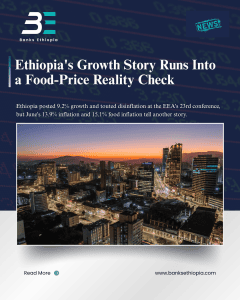
Ethiopia’s Growth Story Runs Into a Food-Price Reality Check
Economists and policymakers gathered in Addis Ababa this month for the Ethiopian Economics Association’s 23rd International Conference on the Ethiopian Economy, under the theme “Shaping Equitable and Sustainable Development in a Changing Global Landscape.” The tone from the podium was upbeat. The tone from the market has been less so.
Finance Minister Ahmed Shide told the July 17 to 18 gathering that the economy expanded 9.2 percent in the past fiscal year, powered by agriculture, services and industry, and pressed the case for sharper export competitiveness, faster implementation of reforms, and more productive employment. Participants used the platform to call for a more adaptive development strategy as global headwinds, from trade tensions to shifting development financing, reshape the country’s options. The conference also honoured Professor Berhanu Nega and Dr. Assefa Admassie for their contributions to the association.
A Reform Narrative Built on Disinflation
The growth figures cited at the conference sit inside a broader story the government has been telling since late last year: that coordinated fiscal and monetary reform under the Homegrown Economic Reform Agenda was delivering both faster growth and falling prices at the same time. Inflation fell to single digits in December for the first time in years, reaching 9.7 percent, before easing further to 9.4 percent in March. Officials credited tighter money supply growth, an end to direct central bank financing of the budget deficit, and productivity gains for the improvement.
That narrative has been central to the case for the reform program heading into an election year, and it featured again at the EEA conference as officials framed the past year’s growth as evidence the strategy is working.
The Numbers Since March Tell a Different Story
Ethiopia’s Consumer Price Index has moved the other way for three straight months. Headline inflation reached 13.9 percent in June, up from 13.4 percent in May, the highest reading in a year. Food inflation, which carries the heaviest weight in most household budgets, climbed to 15.1 percent, its highest level since January 2025. Bread and cereals rose 7.3 percent, vegetables 12.8 percent, and non-food categories including education and housing accelerated as well.
The gap between the reform narrative presented at events like the EEA conference and the price data households are living with is now the more consequential story for banks, borrowers and depositors. A growth rate above 9 percent is genuinely strong by regional and global standards. But if food and consumer prices keep climbing through the second half of the year, the disinflation achievement that has anchored the government’s economic message since December will be harder to sustain.
What It Means for the Banking Sector
For lenders, the tension has practical consequences. A market-based interest rate system, introduced as part of the same reform package, now gives commercial banks autonomy to price loans and deposits against market conditions rather than fixed benchmarks. That autonomy becomes harder to exercise confidently when inflation expectations are moving upward again after months of decline. Renewed price pressure also raises the risk that the National Bank of Ethiopia holds monetary policy tighter for longer, delaying the interest rate relief that businesses and retail borrowers have been anticipating since inflation first fell into single digits.
Growth of 9 percent and rising food prices are not necessarily contradictory in the short run. But sustaining both the growth narrative and the disinflation narrative through the same fiscal year will require the July and August CPI readings to show the June acceleration was temporary, not the start of a longer trend.
What to Watch Next
- Whether the National Bank of Ethiopia signals any policy shift in response to three consecutive months of rising inflation
- The July CPI release, due next month, as the next test of whether food-price pressure is easing or building
- How the government’s 10.1 percent growth projection for the new fiscal year holds up against renewed inflation
- Follow-through from the EEA conference’s call for a more adaptive development strategy, and whether it translates into policy changes
Sources: Ethiopian Economics Association 23rd International Conference on the Ethiopian Economy (July 2026); Ministry of Finance budget presentations; Ethiopian Statistical Service Consumer Price Index releases.